
How Long Does CBD Stay in Your System?


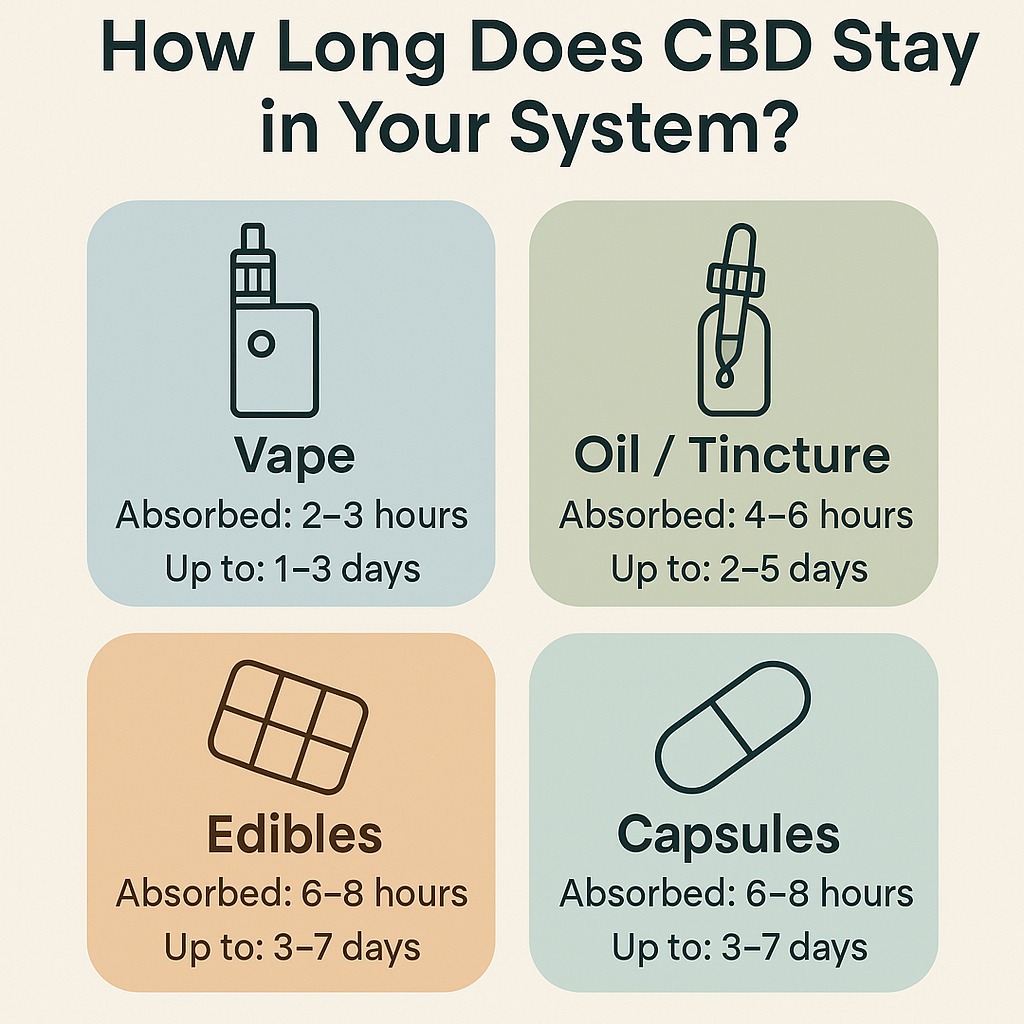
Quick Answer: CBD can stay in your system for 2 to 5 days after a single use — but in regular users, it may be detectable for up to 1–2 weeks depending on dosage and form (oil, capsule, edible, etc.).
If you use CBD—or you’re thinking about starting—it’s totally normal to wonder how long it stays in your system. This question usually comes up around things like work schedules, travel, or drug testing, and the honest answer isn’t as simple as a number of hours or days.
The truth is, CBD doesn’t behave the same way for everyone. How long it may remain in your system depends on a mix of product type, how often you use it, and how your body processes cannabinoids.
Let’s break it down in a way that actually makes sense.
Does CBD Show Up on a Drug Test?
In most cases, CBD alone does not show up on standard drug tests. These tests are designed to detect THC metabolites, which are linked to psychoactive cannabis—not CBD.
That said, there’s an important detail people often miss:
Some CBD products may contain trace amounts of THC, depending on how they’re made.
This is why the difference between CBD types—and proper lab testing—really matters.
What Actually Affects How Long CBD Stays in Your System?
CBD is processed by the body through normal metabolic pathways, and several factors can influence how long cannabinoids may remain detectable.
Here’s a simple overview:
| Factor | Why It Matters |
|---|---|
| Type of CBD product | Full-spectrum products may contain trace THC, while isolate does not |
| How often you use CBD | Occasional use vs. daily routines can affect retention |
| Amount used | Higher amounts may take longer to process |
| How you take it | Oils, capsules, edibles, and inhaled formats are handled differently |
| Your metabolism | Everyone processes cannabinoids at a different pace |
These factors interact with each other, which is why two people using the same product can have very different experiences.
Does the Type of CBD Matter?
Yes, it does.
-
CBD Isolate contains CBD only, with no other cannabinoids
-
Broad-Spectrum CBD contains multiple hemp compounds with THC removed
-
Full-Spectrum CBD contains naturally occurring cannabinoids, including compliant trace levels of THC
If drug testing is a concern, this distinction is especially important.
Is There a Set Timeline for CBD?
You’ll see a lot of articles online claiming CBD “stays in your system” for a specific number of days. In reality, there is no scientifically fixed clearance time that works for everyone.
What we do know:
-
CBD is processed through the liver and digestive system
-
Cannabinoids don’t behave the same way in every body
-
Detection windows depend on multiple variables
Any timeline you see online should be treated as a general reference, not a guarantee.
What About THC-Free CBD?
Many people choose THC-free CBD products to reduce concerns around testing. These are typically made using CBD isolate or specially refined extracts.
A few things to keep in mind:
-
“THC-free” means THC is not intentionally included
-
Third-party lab testing is essential for verification
-
Batch-to-batch testing matters more than marketing claims
Checking lab reports is the best way to understand what you’re actually using.
Can Dosage Affect How Long CBD Stays in Your System?
Yes — amount and consistency matter.
Using more CBD, or using it very consistently, can influence how long cannabinoids are processed by your body. That’s why many people start with lower amounts and adjust gradually.
If you’re unsure where to begin, CBD2GO has a helpful tool that walks you through it:
👉 CBD Dosage Guide & Calculator:
https://cbd2go.co/dosage-size-of-cbd-how-much-cbd-to-take/
It’s designed to give you a practical starting point based on your routine and preferences.
Can CBD Affect Workplace Drug Testing?
CBD itself isn’t what drug tests look for—but THC exposure is the main concern.
If testing matters to you:
-
Choose clearly labeled, lab-tested products
-
Understand the difference between CBD types
-
Avoid assuming “natural” means risk-free
Everyone’s situation is different, so informed choices matter.
Is CBD Legal in Canada?
Yes. CBD is legal in Canada when purchased from compliant retailers that follow federal regulations for testing, labeling, and cannabinoid limits.
Final Thoughts
There’s no universal answer to how long CBD stays in your system—and that’s okay. What matters most is understanding:
-
The difference between CBD and THC
-
How product type and consistency affect outcomes
-
That individual metabolism plays a big role
Clear labeling, third-party testing, and mindful use go a long way toward reducing uncertainty.
Legal & Safety Notice
19+ only. Not for use if pregnant or nursing. Consult a healthcare professional before use. Void where prohibited by law.
Usually 30–60 minutes before bedtime. Oil drops under the tongue absorb fastest; capsules or gummies can take longer.
Yes — they work synergistically for many users. Choose products that clearly state both dosages to avoid over-sedation.
Not necessarily. Very high doses can cause next-day drowsiness. Start small and titrate only if needed.
Many studies indicate full-spectrum CBD (with CBN, terpenes, and trace THC) supports deeper, more consistent sleep due to the entourage